
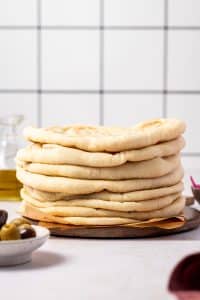
Homemade Pita Bread Recipe
This easy Homemade Pita Bread Recipe uses simple pantry ingredients and can be cooked on the stovetop or baked in the oven. Soft, fluffy, and perfect for stuffing, dipping, or serving with your favorite Mediterranean-inspired meals.
Servings: 8 pita
Calories: 208kcal
Ingredients
- 3 cups all-purpose flour - plus more for dusting
- 1 packet instant yeast - (2 ¼ teaspoons)
- 1 teaspoon salt
- 2 teaspoons sugar
- 2 tablespoons olive oil
- 1 ¼ cups warm water - (105–110°F)
Instructions
- Combine the dry ingredients. Add the flour, instant yeast, salt, and sugar to a large mixing bowl or the bowl of a stand mixer. Whisk until evenly combined.
- Add the water and olive oil. Make a well in the center of the flour mixture. Pour in the olive oil and warm water, then stir with a wooden spoon or sturdy spatula until a rough, shaggy dough forms.
- Knead the dough. If using a stand mixer, attach the dough hook and knead on medium speed for 7-8 minutes, or until the dough is smooth and elastic. To knead by hand, transfer the dough to a lightly floured surface and knead for 10-12 minutes. The dough should be soft and slightly tacky, but not wet.
- Let the dough rise. Lightly oil a clean bowl. Add the dough and turn it once to coat the outside with oil. Cover with a clean kitchen towel or plastic wrap and let it rise in a warm, draft-free place for about 1 hour, or until doubled in size.
- Divide and shape. Gently punch down the dough to release the air. Transfer it to a lightly floured surface and divide it into 8 equal pieces. Shape each piece into a smooth ball.
- Roll the pita. Use a rolling pin to roll each dough ball into a circle about 1/4-inch thick and 6-7 inches wide. Keep the thickness as even as possible. Cover the rolled pita rounds with a clean towel and let them rest for 15 minutes.
- Cook on the stovetop. Heat a cast-iron or nonstick skillet over medium-high heat until very hot. Place one pita round in the skillet and cook for 1-2 minutes, or until bubbles form and the bottom is golden brown. Flip and cook for another 1-2 minutes. Transfer to a clean kitchen towel and cover to keep warm. Repeat with the remaining dough.
- Or bake in the oven. Preheat the oven to 475°F with a pizza stone or heavy-duty baking sheet inside. Carefully place 1-2 pita rounds on the hot surface and bake for 3-4 minutes, or until puffed and lightly golden. Remove right away and wrap in a clean kitchen towel to keep soft.
Notes
Please note, this recipe uses instant yeast. Sometimes called rapid-rise or quick-rise yeast, instant yeast is a type of dry yeast that is designed to activate quickly. Unlike other types of yeast, it can be mixed directly into dry ingredients without needing to be dissolved in water first (a process called “proofing”). Because of its fast action and direct mixing, it’s perfect for recipes that need a single rise.
- Measure the flour carefully: Too much flour can make the pita dry and dense. For the most accurate results, use a kitchen scale or spoon and level the flour into the measuring cup.
- The dough should be slightly tacky: Soft, slightly sticky dough makes softer pita bread. Avoid adding too much extra flour while kneading or rolling.
- To use active dry yeast: Proof it in warm water with sugar for 5-10 minutes, or until foamy.
- Whole wheat option: Replace half of the all-purpose flour with whole wheat flour for a slightly nutty flavor. Using only whole-wheat flour may make the pita denser.
- Bread flour option: Bread flour can be used for a slightly chewier pita.
- For puffy pita pockets: Roll the dough evenly, keep it covered so it does not dry out, and cook it on a very hot skillet, baking sheet, or pizza stone.
- Do not press the pita while cooking: Pressing down can prevent steam from forming inside the dough, which is what helps create the pocket.
- Keep pita soft: Wrap each cooked pita in a clean kitchen towel as soon as it comes off the heat.
- Storage: Store cooled pita bread in an airtight container or resealable bag at room temperature for 2-3 days.
- Freezing: Freeze cooled pita with parchment paper between each one in a freezer-safe bag for up to 2 months.
- Reheating: Reheat pita in a warm oven, hot skillet, or microwave wrapped in a damp paper towel until soft and warm.
- Gluten-free note: I have not tested this recipe with gluten-free flour, so I cannot guarantee the results. For best results, use a pita recipe specifically developed for gluten-free flour.
Nutrition
Calories: 208kcal | Carbohydrates: 37g | Protein: 5g | Fat: 4g | Saturated Fat: 1g | Polyunsaturated Fat: 1g | Monounsaturated Fat: 3g | Sodium: 292mg | Potassium: 59mg | Fiber: 2g | Sugar: 1g | Vitamin C: 0.003mg | Calcium: 8mg | Iron: 2mg
Did you make this recipe?Tag @theforkedspoon and hashtag it #theforkedspoon and please leave your star rating in the comment section on this post.
Copyright © 2026 The Forked Spoon
