
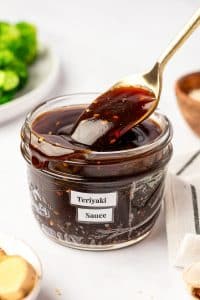
Teriyaki Sauce Recipe
This easy homemade teriyaki sauce is sweet, savory, thick, glossy, and ready in about 10 minutes. Use it as a stir-fry sauce, dipping sauce, glaze, or skip the cornstarch slurry to make a flavorful teriyaki marinade.
Servings: 8 servings (¼ cup each)
Calories: 142kcal
Ingredients
- 1 cup low-sodium soy sauce -
- ¾ cup brown sugar
- 2 tablespoons honey - or more brown sugar
- 3 tablespoons rice wine vinegar
- ½ teaspoon ground ginger - or 1 tablespoon freshly grated ginger
- ½ teaspoon garlic powder - or 4 cloves garlic, minced
- 1 tablespoon sesame oil - optional
- ¾ cup water
- 3 tablespoons cornstarch - mixed with 4 tablespoons cold water
- sesame seeds - to garnish, optional
Instructions
- Combine the sauce ingredients. Add the soy sauce, brown sugar, honey, rice wine vinegar, ground ginger, ground garlic, sesame oil, and water to a small saucepan. Whisk well to combine.1 cup low-sodium soy sauce, ¾ cup brown sugar, 2 tablespoons honey, 3 tablespoons rice wine vinegar, ½ teaspoon ground ginger, ½ teaspoon garlic powder, 1 tablespoon sesame oil, ¾ cup water
- Bring to a simmer. Place the saucepan over medium heat and bring the mixture to a gentle simmer, stirring often so the sugar dissolves.
- Simmer briefly. Reduce the heat to low and simmer for 3-4 minutes, stirring occasionally.
- Make the cornstarch slurry. In a small bowl, whisk together the cornstarch and cold water until smooth. Make sure there are no dry clumps of cornstarch remaining.3 tablespoons cornstarch
- Thicken the sauce. Slowly pour the cornstarch slurry into the simmering sauce while whisking constantly. Continue cooking for 1-2 minutes, or until the sauce is thick and glossy and coats the back of a spoon.
- Finish and serve. Remove from heat and stir in sesame seeds, if desired. Use immediately, or let the sauce cool completely before transferring it to an airtight jar or container.sesame seeds
Notes
This teriyaki sauce recipe makes about 2 cups of sauce, which is roughly 8 servings at ¼ cup each.
- For a thinner teriyaki marinade: Skip the cornstarch slurry. The sauce will be thinner and easier to pour over chicken, beef, pork, salmon, shrimp, tofu, or vegetables.
- For a pourable sauce: Use about half of the cornstarch slurry, then add more only if needed. This is best for stir-fries, rice bowls, noodles, and drizzling.
- For a thicker glaze: Use the full cornstarch slurry and simmer until the sauce is glossy, slightly syrupy, and coats the back of a spoon.
- Use low-sodium soy sauce: Regular soy sauce can make the sauce taste too salty, especially after simmering.
- Vegan: Replace the honey with additional brown sugar.
- Gluten-free: Replace regular soy sauce with an equal amount of coconut aminos or liquid aminos or use a gluten-free soy sauce such as this San-J Tamari Gluten-Free Soy Sauce.
- Cornstarch tip: Always mix cornstarch with cold water before adding it to hot sauces. Adding dry cornstarch directly to the pan can make the sauce clumpy.
- The sauce thickens as it cools: Remove it from the heat when it is slightly thinner than your ideal consistency.
- Storage: Let the sauce cool completely, then refrigerate it in an airtight jar or container for up to 2 weeks.
- Freezing: Freeze in small airtight containers or ice cube trays for up to 3 months. Thaw overnight in the refrigerator before using.
- Reheating: Warm gently in a small saucepan or in the microwave in short intervals, stirring often. Add a splash of water if the sauce is too thick.
Nutrition
Calories: 142kcal | Carbohydrates: 29g | Protein: 3g | Fat: 2g | Saturated Fat: 0.3g | Polyunsaturated Fat: 1g | Monounsaturated Fat: 1g | Sodium: 1155mg | Potassium: 146mg | Fiber: 0.3g | Sugar: 24g | Vitamin A: 0.04IU | Vitamin C: 0.03mg | Calcium: 28mg | Iron: 1mg
Did you make this recipe?Tag @theforkedspoon and hashtag it #theforkedspoon and please leave your star rating in the comment section on this post.
Copyright © 2026 The Forked Spoon
