
This post may contain affiliate links. See my disclosure policy.

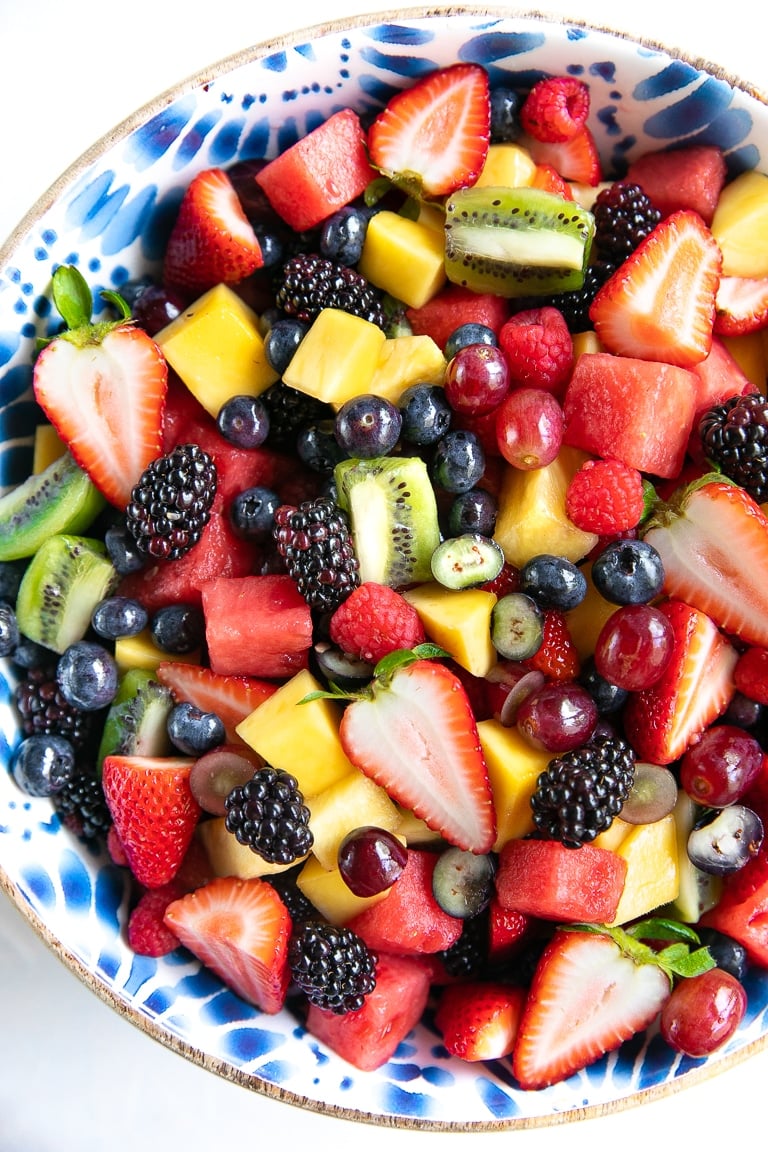
This quick and easy fruit salad recipe features a variety of fresh, colorful, in-season fruit in a bright orange-lemon dressing. Made without any added sugar or sweeteners, it’s the perfect summer side dish, snack, or dessert!
Featured Reader Comments
⭐⭐⭐⭐⭐
“I rarely leave reviews, but this was absolutely amazing! I followed the recipe exactly. I forgot my raspberries at home when I left for the dinner party and it was still delicious. This simple dressing was perfect to enhance the bowl of sweet and colorful fruit…”
-Laurel“I followed the recipe exactly as listed and it’s absolutely perfect. The mango gives the bowl all the delicious sweetness it needs. The flavors are all well balanced.”
-Ani
My mom was a fantastic cook. Growing up, she loved to make special dinners for me and my siblings each weekend. She would handle the main dish, while us kids would tackle the salad. Come summer, this meant one thing — fruit salad. My brother, sister, and I were in charge of picking the best looking fruit, then helped wash, chop, and mix everything together. We learned quickly that bananas were the absolute worst fruit for fruit salads, while watermelon, strawberries, grapes, and pineapple were the best. Our fruit salads were always too big for just four people, but we didn’t mind. Leftovers meant one thing: fresh fruit for breakfast the next morning.
To this day, fruit salad still feels like one of the best parts of childhood — and summer.
Today, I’m sharing how to make a classic fruit salad, along with my best tips, tricks, subs and swaps depending on what’s in season. This fruit salad is special because there is no added sugar, syrup, or goopy dressing. Just fresh, sweet, juicy fruit and a simple 2-ingredient orange-lemon “dressing.”
Share it with friends at your next picnic, potluck, or backyard BBQ, or make it with your kids — the memories may just last a lifetime.
Table of Contents
Best Fruits for Fruit Salad
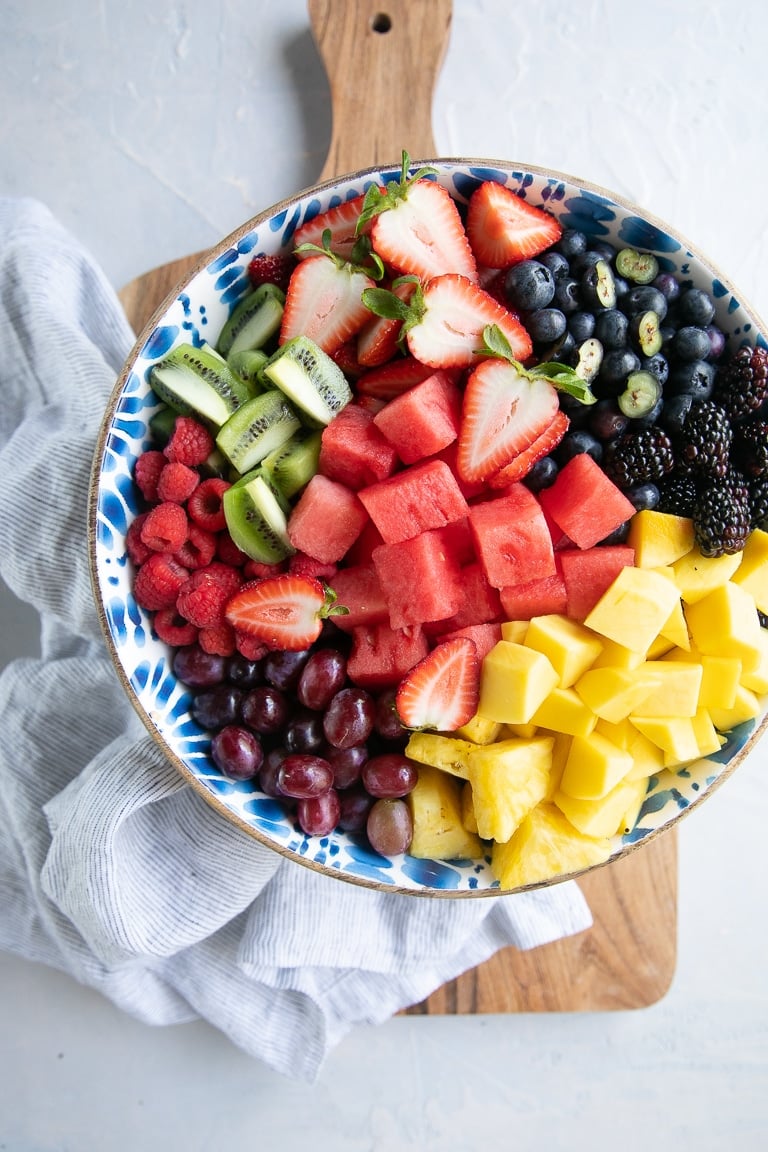
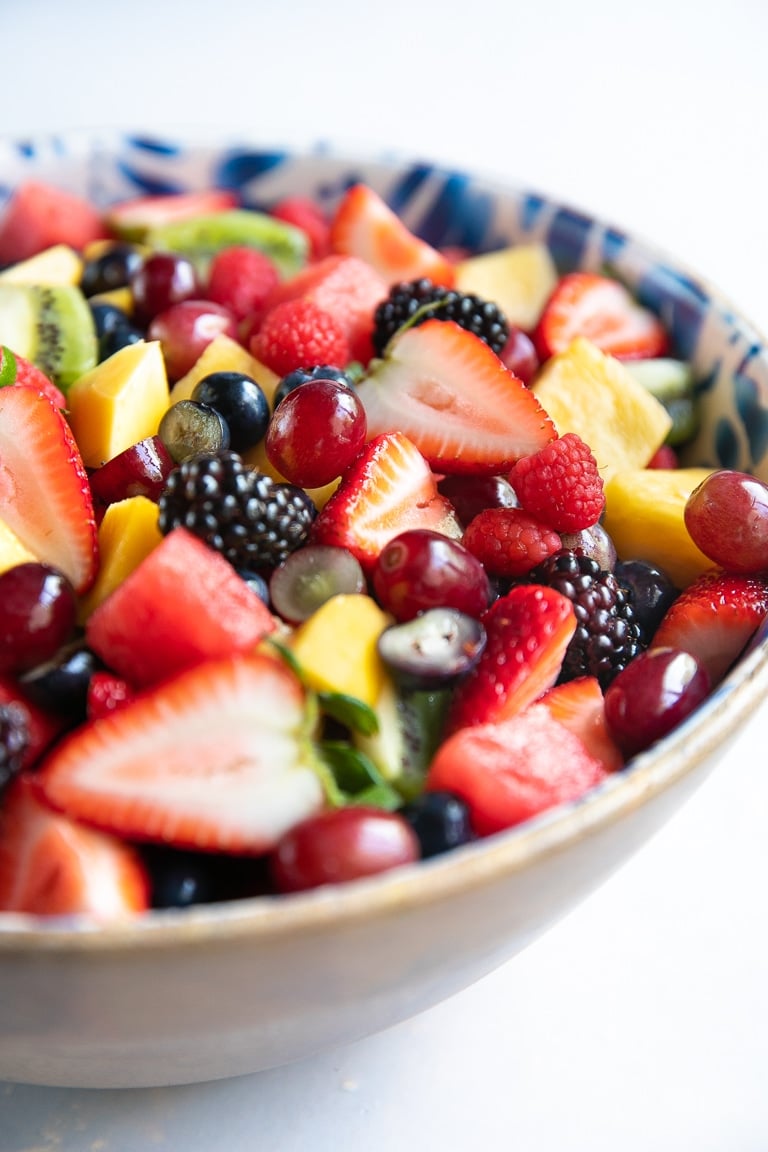
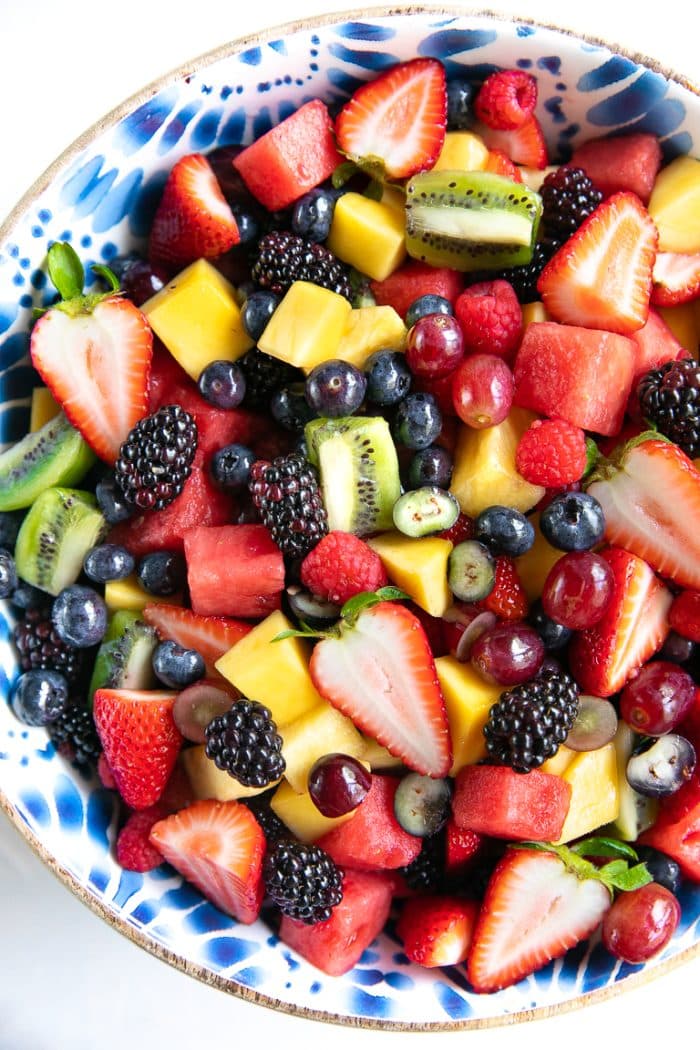
The best fruits for fruit salad are sweet, colorful, and sturdy enough to hold their shape after mixing. For this fruit salad recipe I included: blueberries, strawberries, raspberries, and blackberries, plus grapes, pineapple, watermelon, mango, and kiwi. Feel free to use your favorite fruits by season or depending on what looks fresh.
Below are some of the most popular fruits for fruit salad (ordered alphabetically), including when they are in season, how to tell if they are ripe, and the best time to add them.
- Apples (fall through winter): Choose crisp apples without bruises or soft spots. Core and chop, then toss with citrus juice to help prevent browning. I usually add apples shortly before serving so they stay crisp and crunchy. Honeycrisp and Pink Lady apples are a unanimous Randhawa-family favorite.
- Blackberries (summer to early fall): Choose plump, deep-colored berries without mold or leaking juice. Rinse gently and dry well. Add near the end and toss carefully so they do not break apart.
- Blueberries (late spring through summer): Choose plump, firm berries with smooth, taut skin. Rinse and dry well before adding. These little gems hold up beautifully, so feel free to add them anytime.
- Cantaloupe (summer): Choose one that smells sweet and feels heavy for its size. Remove the rind and seeds, then cut into cubes or melon balls. It is especially refreshing when chilled straight from the fridge.
- Cherries (late spring to summer): Look for firm, glossy cherries with fresh green stems. Rinse, stem, and pit before adding. You can also add cherries with the stem still attached. Add anytime, but toss gently so they do not stain the lighter fruits too much.
- Grapes (late summer to fall): Look for firm, plump, seedless grapes. Remove from the stems, wash, and slice in half, especially if serving kids. Grapes are one of my favorite fruit salad additions as they stay crisp and juicy for hours.
- Honeydew melon (summer to early fall): Look for honeydew that feels heavy, has a slightly waxy rind, and gives just a little at the blossom end. Remove the rind and seeds, then cut into cubes. Similar to watermelon and cantaloupe, chill first for the best flavor.
- Kiwi (fall through spring): Choose kiwi that gives slightly, but still feels firm. If they’re too soft, they’ll turn to mush. Too firm and they’ll taste slightly sour (I actually prefer slightly under-ripe kiwi, but I’ll let you decide for yourself). Peel and slice or cut into half-moons. Add shortly before serving so it keeps its shape.
- Mandarin oranges (winter): Fresh, peeled mandarins taste a million times better than canned mandarin oranges. Peel and separate into segments, removing any seeds or excess white pith. Add near the end and toss gently since they can break apart easily.
- Mango (spring through summer): Mango is an easy way to make fruit salad taste more tropical and special. Mangoes should give slightly when gently pressed, but shouldn’t feel mushy. The skin should be smooth, not wrinkly. Peel and cut into cubes. Add shortly before serving if very ripe, or at any time if still firm. Learn how to cut a mango.
- Nectarines (summer): Choose nectarines that smell sweet and give slightly without feeling mushy. Pit and slice or chop. They add the same sweet summer flavor as peaches, but with a little extra firmness.
- Oranges (winter to spring): Choose oranges that feel heavy for their size and smell sweet. Peel and segment them, removing seeds and excess pith. Bonus points if you save a little juice for the dressing.
- Peaches (summer): Look for fragrant peaches that give slightly when gently pressed. Pit and slice or chop. Add shortly before serving since they are soft, juicy, and messy – in the best way possible.
- Pears (fall through winter): Choose pears that are ripe but still firm. Core and chop, then toss with citrus juice to slow browning. Pears add a mellow sweetness and soft bite that pairs nicely with crisp apples. Bartlett and French butter pears are my favorite.
- Pineapple (spring through summer): A ripe pineapple should smell sweet at the base and have a little give without feeling soft or mushy. If the pineapple has a strong fermented odor, it may be past its prime. A green pineapple indicates that it isn’t ripe; a yellow, stinky, or soft pineapple indicates that it is too ripe. Learn how to cut a pineapple into rings, slices, and chunks.
- Pomegranate arils (fall through winter): Use bright, juicy arils without any brown or mushy pieces. Remove from the pomegranate or buy ready-to-use arils (what I usually do). Sprinkle them over the top just before serving for a pop of color, crunch, and sparkle.
- Raspberries (summer to early fall): Raspberries can be tricky. Look for bright, plump berries that are not mushy or moldy. Do not rinse until just before using, then dry very gently. Add right before serving since they are delicate and tend to disappear fast once everyone starts snacking.
- Strawberries (spring to early summer): Look for bright red, juicy strawberries with black seeds and green tops. Avoid berries with mold and soft spots. Hull and slice just before adding to the salad.
- Watermelon (summer): Look for a heavy watermelon with a creamy yellow field spot and a deep, hollow sound when tapped. Fortunately, even if your watermelon is a “dud,” there are so many other delicious fruit flavors going into this salad that the watermelon will absorb them like a sponge. I find that watermelon tastes best (and is sweeter) when it’s cold, so I often chop and refrigerate it before mixing.
The Easiest 2-Ingredient Fruit Salad Dressing
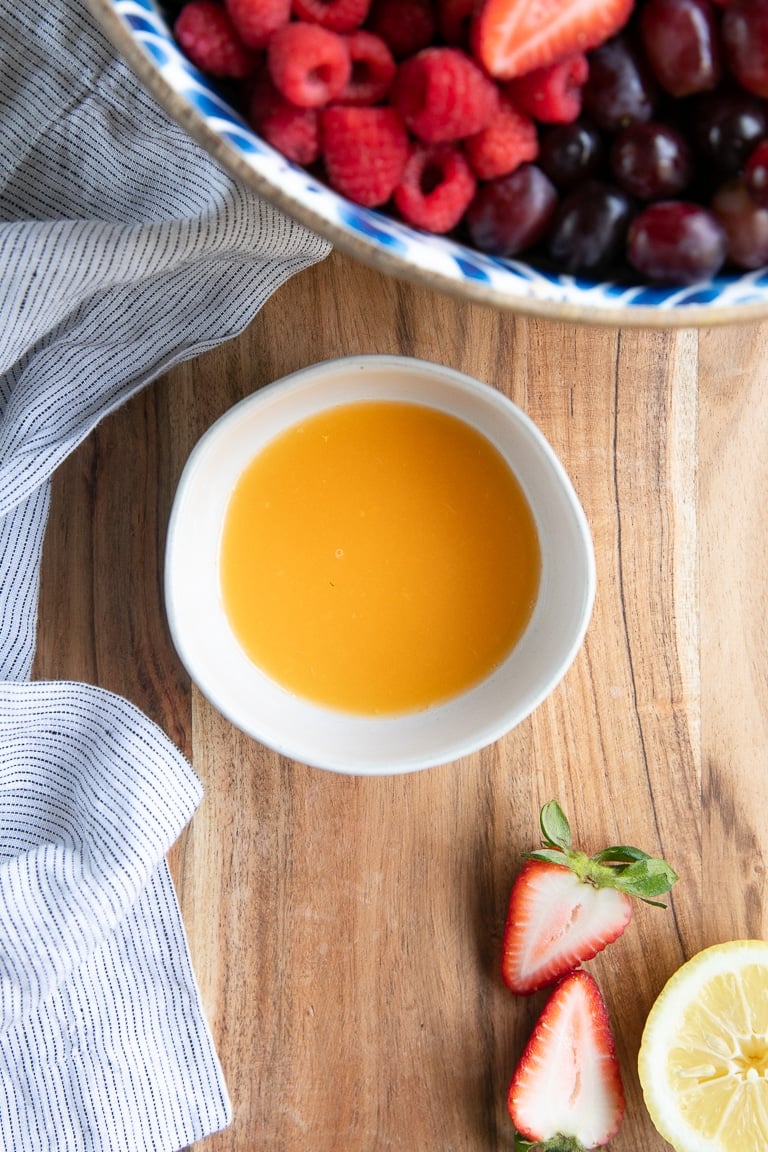
This fruit salad dressing could not be easier. All you need is the juice of 1 large orange plus the juice of 1 lemon. That’s it. No added sugar, honey, syrup, or heavy dressing.
The orange juice adds natural sweetness, while the lemon juice keeps everything bright and fresh. Together, they help bring out the natural juices in the fruit without overpowering the salad.
Possible add-ins: For extra flavor, whisk in a little orange zest, lemon zest, lime zest, poppy seeds, or grated fresh ginger. You can also add a small drizzle of honey if your fruit is not very sweet, but I usually prefer to keep this salad naturally sweetened with fruit juice only.
How to Make Fruit Salad
The key to making the best fruit salad is to add the sturdier fruits first, save the delicate fruits for last, and toss everything gently with just enough citrus dressing to coat. Here’s how to make it:
- Prepare the fruit salad dressing: You guys, I hate to call it a “dressing,” but sometimes things need titles. In this case, we’re tossing the fruit with freshly squeezed orange juice and lemon juice. We don’t want to add too much juice, just enough to coat the fruit. If you don’t have any fresh orange juice or lemon juice, substitute with pineapple juice or lime juice. For even more flavor, add a little lemon or lime zest.
- Chop the fruit: Most of the work and time is spend chopping the fruit. Try to chop the fruit into similar-sized pieces, so that you get a mix of fruits with each bite.
- Combine: Add the sturdy fruit first: grapes, pineapple, blueberries, mango, watermelon, cantaloupe, honeydew, and apples (if tossed with citrus juice). Drizzle with half of the orange-lemon dressing, and gently toss to combine. Add the remaining fruit just before serving (strawberries, blackberries, peaches, nectarines, pears, pomegranate arils, cherries, kiwi, and oranges). Drizzle with the remaining orange juice mixture and gently toss to combine.
- Serve: Add the raspberries and serve immediately.
Tips for Making the Best Fruit Salad
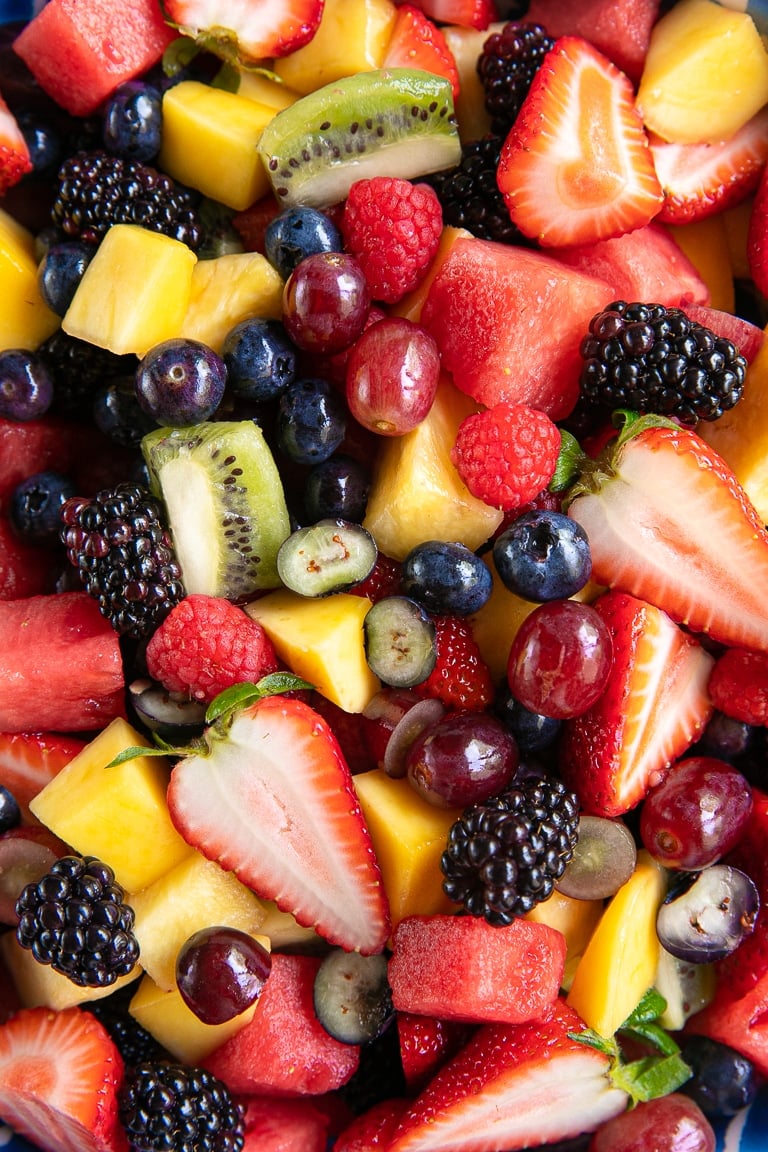
These simple fruit salad tips will help keep your fruit fresh, colorful, and delicious without turning mushy or watery.
- Mix gently: When mixing everything together, I highly recommend using your hands. Just make sure they are clean. This helps prevent the fruit from getting smashed or bruised, especially if you are using softer fruits like berries, mango, or kiwi.
- Add delicate fruit last: Add delicate or very ripe fruit, such as raspberries, kiwi, or peaches, near the end. Raspberries are especially delicate, so add them last and toss very gently, or simply scatter them over the top.
- Taste before adding sweetener: For a sweeter fruit salad, whisk a few tablespoons of honey or brown sugar into the orange and lemon juice. That said, I recommend tasting it as-is first. Fresh summer fruit is usually sweet enough on its own.
- Bananas aren’t great in fruit salads: I do not recommend adding bananas unless you know the fruit salad will be finished within a couple of hours. Bananas brown quickly and do not store well once mixed with other fruits.
Can You Use Frozen Fruit for Fruit Salad?
I do not recommend adding frozen fruit to this fruit salad. Once thawed, frozen fruit is usually too soft and releases excess liquid, which can make the salad watery and mushy. Frozen fruit is better saved for smoothies, sauces, or baked recipes where the softer texture does not matter as much.
Frequently Asked Questions
Can Fruit Salad Be Made Ahead of Time?
You can absolutely prep your fruit salad ahead of time, but I recommend waiting to mix everything together until shortly before serving. This keeps the fruit fresh, colorful, and juicy without turning mushy or watery.
What I usually do is chop the sturdier fruits first, like the watermelon, pineapple, and mango, then store them in separate airtight containers in the refrigerator. I also wash and dry the berries and grapes, then return them to the fridge until I am ready to assemble. When it is time to make the fruit salad, I juice the orange and lemon, peel and chop the kiwi, slice the strawberries, and gently mix everything together.
How Long Does Fruit Salad Last?
Leftover fruit salad is best enjoyed within 2-3 days. It may not look quite as pretty after the first day, but it will still taste delicious. Store leftovers in an airtight container in the refrigerator and give everything a gentle stir before serving.
What Can I Do with Leftover Fruit Salad?
Leftover fruit salad is perfect for quick breakfasts, snacks, and easy desserts. Here are a few of my favorite ways to use it:
- Mix it with vanilla yogurt for a simple fruit and yogurt bowl.
- Blend it into a smoothie.
- Top it with whipped cream and a sprinkle of granola.
- Spoon it over smoothie bowls or overnight oats.
- Serve it over pound cake, angel food cake, brownies, or ice cream.
- Blend and freeze it into homemade fruit popsicles.
More Easy Fruit Salad Recipes


If you try making this easy fruit salad recipe, I’d love to hear what you think! Please leave a comment and a star rating below. Your feedback helps other readers discover (and enjoy) this recipe too. Thank you so much! 💛
Fruit Salad Recipe

Ingredients
- 1 large orange, juiced
- 1 lemon, juiced
- 2 cups seedless red grapes
- 1 pineapple, cored and chopped into chunks
- 4 mango, peeled, cored, cubed
- 6 ounces blueberries
- 2 pounds strawberries, halved
- 6 cups watermelon, cubed
- 12 ounces blackberries
- 5 kiwi, peeled and quartered
- 6 ounces raspberries, (see notes)
Instructions
- Prepare the orange juice "dressing". Add the fresh orange juice and lemon juice to a small bowl. Mix to combine and set aside.
- Prepare the fruit. Prepare and chop fruit – take care not to chop fruit into pieces that are too large, or too small. If they are too small, they will turn mushy faster, and will not taste as fresh should you end up with leftovers.
- Mix.Add the sturdier fruits to a large mixing bowl first (grapes, pineapple, mango, watermelon, and blueberries). Drizzle with half of the orange-lemon dressing and gently toss to combine. Add the remaining fruit, except for the raspberries, and drizzle with the remaining dressing. Toss gently.
- Serve. Add the raspberries last, or scatter them over the top of the fruit salad. Serve immediately, or cover and refrigerate until ready to enjoy.
Video
Notes
- Raspberries and other overly-ripe fruit do not hold up well when mixed around a bunch. For these fruits, I recommend adding them at the very end or simply placing them right on top of the bowl.
Explore More with AI
Nutrition
Nutrition information is automatically calculated, so should only be used as an approximation.










Can u please tell me how many the fruit salad recipe serves if I make a “1X the recipe and how many does it serve if I make the same “Fruit Salad recipe 2X.?
I have to serve 14 women.
Hi Gita! The 1X recipe serves about 18 people as a side, so it should be plenty for 14 women. The 2X recipe would serve about 36. I would stick with the 1X batch for your group! 🙂
I made this for a potluck picnic. Everyone brought potato salad, caesar salad, or some other leafy salad. This is gone in 20 mins…like completely empty, with some upset that they weren’t able to get some. Thanks so much for the idea, definitely doing this again for a big potluck event!
Thank you so much, Matty! I am so glad it was such a hit at the potluck picnic. Completely gone in 20 minutes is the best kind of recipe review! 🙂
Excellent fruit salad recipe. Have made a few times for parties and there’s none left at the end. Thanks Jessica for another great recipe
Thank you so much, Karen! I am so glad the fruit salad has been such a hit at your parties. No leftovers is always the best compliment! 🙂
I’m making this fruit salad for breakfast brunch in the morning. My question: I’m chilling salad overnight and wonder if it’s best to go ahead and mix in dressing tonight, or wait with dressing until morning?
Thank you.
If you are making the fruit salad the night before, I recommend waiting until the morning to add the dressing. This keeps the fruit from releasing too much juice overnight and helps the salad stay fresher and more vibrant. Just give it a quick toss with the dressing right before serving for the best flavor and texture!
Can you use orange juice if you don’t have a fresh orange
Hi Haley! Yes, orange juice will work if you do not have a fresh orange. I would start with about 2 to 3 tablespoons of orange juice, then add a little more if needed. Fresh orange juice will have the best flavor, but bottled orange juice is fine in a pinch. 🙂
Fantastic recipe. Made our Mothers Day.
Thanks for sharing!
Happy Mothers day! Thanks for the review!
What leftovers? My family, and friends, love this so much, I’ve yet to see any leftover. Thank you for the only recipe that pleases everyone in my life!
This absolutely made my day—thank you! I’m so happy to hear it’s such a hit with your family and friends. That’s the best kind of “problem” to have—no leftovers in sight!
This is a beautiful, delicious salad.
I do take exception to the 20 minutes prep time. It took me hours to get the watermelon, pineapple and strawberries ready.
Note: I didn’t add kiwi because my husband is allergic and cheated using frozen mango that saved a lot of time and held up great when thawed.
Thank you so much for the lovely comment—I’m so glad you enjoyed the salad! Great call on skipping the kiwi for your husband and using frozen mango—that’s such a smart shortcut, and I’m happy to hear it held up well. Thanks again for taking the time to share your experience!
I rarely leave reviews, but this was absolutely amazing! I followed the recipe exactly. I forgot my raspberries at home when I left for the dinner party and it was still delicious. This simple dressing was perfect to enhance the bowl of sweet and colorful fruit. I wish I had taken a picture.
I followed the recipe exactly as listed and it’s absolutely perfect. The mango gives the bowl all the delicious sweetness it needs. The flavors are all well balanced.
Thank you for the perfect feedback, Ani 😀
Try a tsp of Vanilla in your “dressing” it adds a fun alternative flavor as well!